Traditional Extraction
A slow extraction process with no water added.
A slow extraction process with no water added.
Taiwanese Silkie chicken is the only ingredient.
| Energy | 23.3 kcal |
|---|---|
| Protein | 5.8 g |
| Fat | 0 g |
| Sodium | 54.5 mg |
Package nutrition values and tested-sample results may differ. Please refer to the actual package label.
Chengyun is made with Silkie chicken, selected for its distinctive flavor and texture.
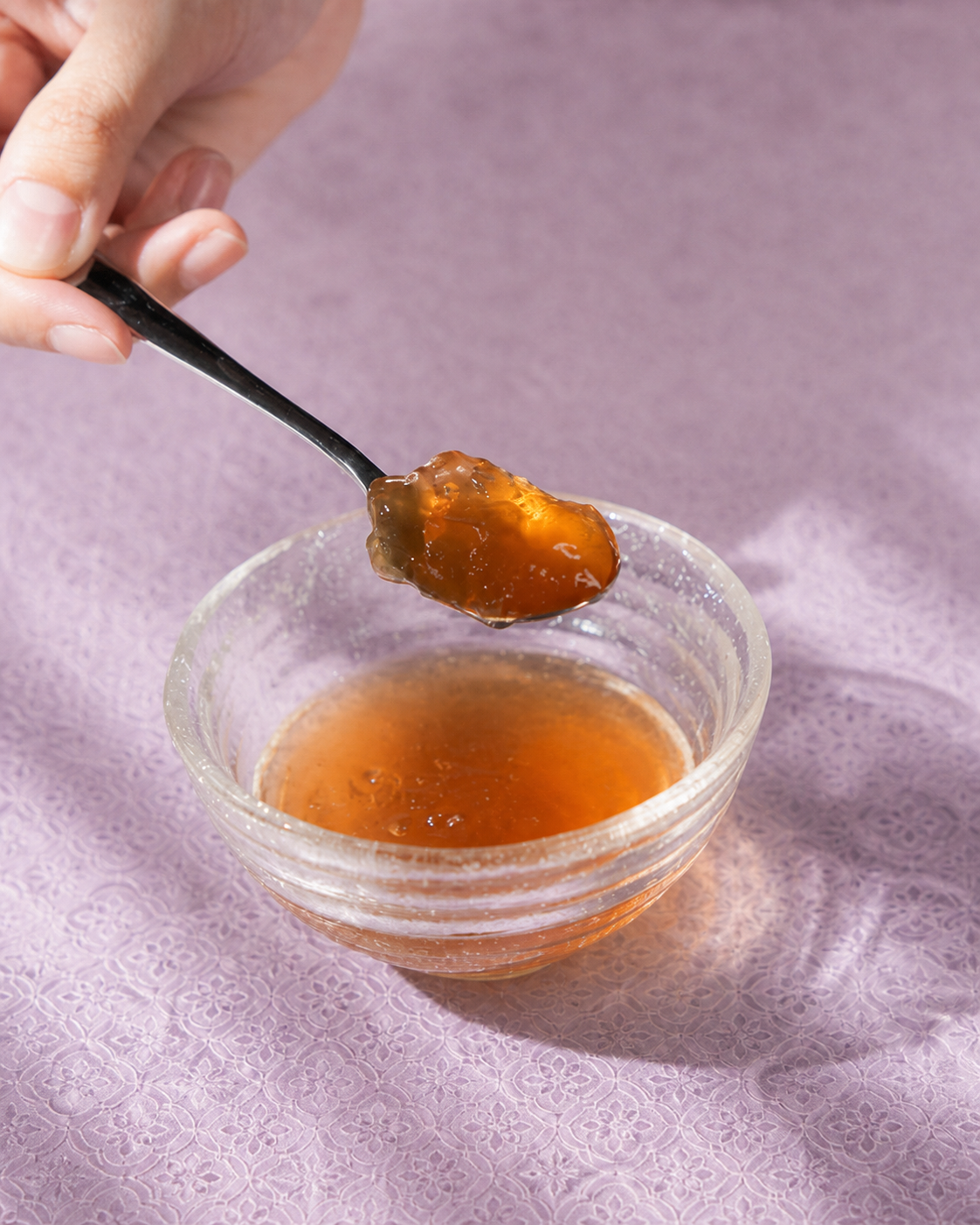
Texture can change naturally with temperature.
Refer to the product label for ingredients and nutrition information.
Food-safety management guides every pouch.
Managed from ingredients through finished goods.
A controlled process supports storage stability.
SGS + FIRDI
Explore independent test results for Chengyun Silkie Chicken Essence, from nutrition and safety to amino acids and collagen.
SGS · ABA26802979
SGS tested nutrition, 48 veterinary drug residues, 9 phthalate plasticizers, microorganisms, and heavy metals in Chengyun Silkie Chicken Essence.
See the approximate protein, energy, and sodium in one 60 mL pouch.
Crude protein
≈ 4.8 g / 60 mL
Calculated from 8.0 g/100 mL
Crude fat
N.D.
Not detected · LOQ 0.1 g/100mL
Sugars
N.D.
Not detected · LOQ 0.5 g/100mL
Energy
≈ 19.2 kcal / 60 mL
Calculated from 32.0 kcal/100 mL
Sodium
≈ 53.2 mg / 60 mL
Calculated from 88.6 mg/100 mL
Explore the veterinary drug, phthalate, and microbiology results.
48
N.D.
All 48 reported items
9
N.D.
All 9 reported items
3
Negative
S. aureus, Enterobacteriaceae, and Salmonella
3
N.D.
Lead, cadmium, and mercury
Nutrition test results and quantification limits are shown per 100 mL.
| Test item | Result | Unit | LOQ |
|---|---|---|---|
| Energy | 32.0 | kcal/100mL | — |
| Crude protein | 8.0 | g/100mL | 0.1 |
| Crude fat | N.D. | g/100mL | 0.1 |
| Sum of saturated fat | N.D. | g/100mL | 0.05 |
| Sum of trans fat | N.D. | g/100mL | 0.05 |
| Carbohydrate | 0.0 | g/100mL | — |
| Sugars | N.D. | g/100mL | 0.5 |
| Moisture | 93.4 | g/100mL | 0.1 |
| Ash | 0.9 | g/100mL | 0.1 |
| Sodium | 88.6 | mg/100mL | 0.2 |
Per-pouch values are estimates calculated from the test results. Please refer to the package for nutrition information.
These are selected results. Please see the original report for every test item.
The report lists 48 veterinary drug residues; every listed result is N.D.
Nine phthalate plasticizers were N.D.: BBP, DBP, DIBP, DEP, DMP, DEHP, DNOP, DINP, and DIDP.
| Test item | Result | LOQ / LOD | Food sanitation standard |
|---|---|---|---|
| Staphylococcus aureus | Negative | 10 CFU/g | — |
| Enterobacteriaceae | Negative | 10 CFU/g | — |
| Salmonella | Negative | — | — |
| Lead (Pb) | N.D. | 0.01 mg/kg | ≤ 0.3 mg/kg |
| Cadmium (Cd) | N.D. | 0.01 mg/kg | — |
| Mercury (Hg) | N.D. | 0.01 mg/kg | — |
SGS · ABA26803557
SGS tested 18 amino acids in Chengyun Silkie Chicken Essence, showing the amount of each one.
Glycine, glutamic acid, and proline have some of the highest levels in this test.
Glycine
12,795 ppm (mg/kg)
Highest concentration among the 18 reported amino acids
Glutamic Acid
7,402 ppm (mg/kg)
Second highest in this 18-item profile
Proline
7,085 ppm (mg/kg)
Third highest in this 18-item profile
Alanine
5,569 ppm (mg/kg)
Fourth highest in this 18-item profile
Arginine
4,757 ppm (mg/kg)
Fifth highest in this 18-item profile
BCAA three-item total
4,234 mg/kg · 423.4 mg/100 g
Isoleucine, leucine, and valine added together; not a separate SGS test item.
Total of 18 items
54,702 mg/kg · 5,470.2 mg/100 g
The 18 results added together; not a separate SGS test item.
All 18 results and quantification limits are shown in ppm (mg/kg).
| Test item | Result | LOQ | Unit |
|---|---|---|---|
| Alanine | 5,569 | 18 | ppm (mg/kg) |
| Arginine | 4,757 | 35 | ppm (mg/kg) |
| Aspartic Acid | 3,424 | 27 | ppm (mg/kg) |
| Cystine | 72 | 24 | ppm (mg/kg) |
| Glutamic Acid | 7,402 | 29 | ppm (mg/kg) |
| Glycine | 12,795 | 15 | ppm (mg/kg) |
| Histidine | 1,492 | 31 | ppm (mg/kg) |
| Isoleucine | 948 | 26 | ppm (mg/kg) |
| Leucine | 1,943 | 26 | ppm (mg/kg) |
| Lysine | 2,282 | 29 | ppm (mg/kg) |
| Methionine | 871 | 30 | ppm (mg/kg) |
| Phenylalanine | 1,283 | 33 | ppm (mg/kg) |
| Proline | 7,085 | 23 | ppm (mg/kg) |
| Serine | 1,629 | 21 | ppm (mg/kg) |
| Threonine | 1,305 | 24 | ppm (mg/kg) |
| Tyrosine | 430 | 36 | ppm (mg/kg) |
| Valine | 1,343 | 23 | ppm (mg/kg) |
| Tryptophan | 72 | 35 | ppm (mg/kg) |
Alanine through valine (17 items): SGS SOP TESP-VC-0040, referring to AOAC 994.12. Tryptophan: SGS SOP TESP-VC-0087, referring to AOAC 988.15.
FIRDI · 115SA02246
FIRDI tested the free amino acids, collagen, iron, and zinc in Chengyun Silkie Chicken Essence.
All amounts below are shown per 100 g.
Total free amino acids
999.4 mg / 100 g
Report total; the individual results add up to 999.39 mg/100 g.
Collagen
6.12 g / 100 g
Reported test result
BCAA three-item total
36.74 mg / 100 g
Valine, isoleucine, and leucine added together; not a separate FIRDI test item.
Taurine
113.25 mg / 100 g
Anserine
455.44 mg / 100 g
Carnosine
115.51 mg / 100 g
Iron
Not detected
LOQ 0.25 mg/100 g
Zinc
Not detected
LOQ 0.25 mg/100 g
BCAA adds the three amino acid results below.
| Test item | Result | Unit |
|---|---|---|
| L-Valine | 12.88 | mg/100 g |
| L-Isoleucine | 8.58 | mg/100 g |
| L-Leucine | 15.28 | mg/100 g |
| Three-item total | 36.74 | mg/100 g |
The report attachment lists 38 components. Hydroxyproline and sarcosine have an LOQ of 0.5 mg/100 g; the other individual components have an LOQ of 0.1 mg/100 g.
| Component | Result |
|---|---|
| o-Phosphoserine | 2.44 |
| Taurine | 113.25 |
| o-Phosphoethanolamine | 2.45 |
| L-Aspartic Acid | 10.24 |
| L-Threonine | 16.21 |
| L-Serine | 23.49 |
| Asparagine | 7.30 |
| L-Glutamic Acid | 56.50 |
| Sarcosine | 0.52 |
| L-2-Aminoadipic Acid | 0.58 |
| Glycine | 25.30 |
| L-Alanine | 35.00 |
| L-Citrulline | 0.62 |
| DL-2-Aminobutyric Acid | 1.04 |
| L-Valine | 12.88 |
| L-Cystine | 0.12 |
| L-Methionine | 5.70 |
| L-Cystathionine | 0.12 |
| L-Isoleucine | 8.58 |
| L-Leucine | 15.28 |
| L-Tyrosine | 8.71 |
| L-Phenylalanine | 6.91 |
| β-Alanine | 6.36 |
| DL-3-Aminoisobutyric Acid | N.D. |
| γ-Aminobutyric Acid | 0.30 |
| Tryptophan | 2.29 |
| Ethanolamine | 2.14 |
| 5-Hydroxy-DL-lysine | 0.83 |
| L-Ornithine | 1.58 |
| L-Lysine | 19.25 |
| L-1-Methylhistidine | 1.48 |
| L-Histidine | 6.24 |
| L-3-Methylhistidine | 0.58 |
| L-Anserine | 455.44 |
| L-Carnosine | 115.51 |
| L-Arginine | 15.79 |
| L-Hydroxyproline | 5.44 |
| L-Proline | 12.92 |
Individual results add up to 999.39 mg/100 g; the report total is 999.4 mg/100 g. N.D. means below the quantification limit.
Iron and zinc were not detected (below the quantification limit). Other heavy metals were not tested in this report.
| Test item | Result | Unit | LOQ | Method |
|---|---|---|---|---|
| Total free amino acids | 999.4 | mg/100 g | — | Ion-exchange chromatography |
| Iron | N.D. | mg/100 g | 0.25 | AOAC 2011.14 |
| Collagen | 6.12 | g/100 g | — | ISO 3496:1994 |
| Zinc | N.D. | mg/100 g | 0.25 | AOAC 2011.14 |
Three selected papers introduce the overall evidence, ingredient background, and human research findings and limitations.
These studies did not test Chengyun Silkie Chicken Essence. Formulations, doses, and participants differ; their findings cannot establish the same effects for this product.
Research topic: A systematic review and meta-analysis of chicken essence and cognitive function.
Summary — Some executive-function analyses were positive, but limited study quality and inconsistent findings leave insufficient convincing evidence to establish cognitive benefits.
Nutrients, 8(1):57. DOI: 10.3390/nu8010057
Read the paperResearch topic: A review of imidazole dipeptides and fatigue research.
Summary — Introduces carnosine and anserine and discusses two human studies related to fatigue. This is early background literature, not a complete account of current evidence.
Japanese Journal of Complementary and Alternative Medicine, 6(3):123–129. DOI: 10.1625/jcam.6.123
Read the paperResearch topic: Repeated chicken essence intake and cognitive performance after mental fatigue.
Summary — Twenty healthy men took part in a placebo-controlled crossover trial. At weeks 1 and 4, reaction times after the post-fatigue rest period were shorter than at baseline; those before and immediately after the fatigue task were unchanged. Placebo showed no comparable significant change, but this alone does not establish superiority over placebo or identify a responsible ingredient.
Medical Science Monitor, 19:540–547. DOI: 10.12659/MSM.883971
Read the paper